


Expert Tips
HOW TO DO WATERPROOFING


Waterproofing is applied to areas where water can enter our structures; foundations, walls in contact with soil, external walls below the level where water can accumulate or press against the structure, balconies, terraces, sloped roofs, and wet areas. For a structure to be long-lasting, it must be designed according to waterproofing rules from the start. In buildings constructed without waterproofing, roof and wet area waterproofing can be easily done later, but for insulating walls below ground, the building's surroundings must be excavated. To waterproof the foundations on which the building sits, the structure would need to be lifted, which is currently not possible. In such cases, only the formation of mold and fungi, which disrupt our comfort, can be prevented. It is not possible to fully protect against the damages water causes to the structure's lifespan after construction. The only feasible application is often to remove water at the foundation level through drainage measures. Another application area of waterproofing is structures where we want to keep water inside, such as pools, water tanks, artificial ponds, etc.
Waterproofing in buildings is done to prevent water, regardless of its intensity, state, or source, from entering through the building envelope and damaging the building elements and thus the structure. Essentially, waterproofing is divided into structural and surface waterproofing.
1- Structural Waterproofing
In general, it is a set of applications that reduce water ingress and its effects by using construction chemicals in powder or liquid form as additives during the production of concrete elements to facilitate production, improve concrete quality, provide desired properties, and achieve water impermeability. Concrete additives and joint materials that reduce capillary voids in concrete by lowering the water/cement ratio and block capillary voids in concrete fall into this category.
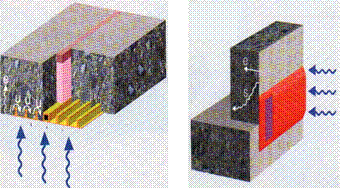
Joint materials applied to the exterior surface: Polyethylene or hypalon water-stopping bands are used to prevent water from entering the expansion or construction joints in concrete. They work on the principle of stopping water or extending its path within the concrete.
Joint materials applied to the concrete structure: Water-stopping bands or water-expanding mastic and profiles are used to prevent water from passing through expansion or construction joints in concrete. They work on the principle of stopping water or extending its path within the concrete.
Joint materials applied to the interior surface: Hypalon water-stopping bands are used to prevent water from passing through expansion or construction joints on the interior surface. They work on the principle of stopping water (Figure 2).
 2- Surface Waterproofing
It is a set of processes carried out to create a water-impermeable layer between the external environment where water may be present and the building envelope. For this purpose, special waterproofing membranes are used.
Waterproofing is done by applying waterproofing membranes to areas where water can enter the structures. Waterproofing applications should preferably be done from the side where the water comes from, i.e., the exterior of the structure.
The first step in applications to be done at the foundation is to conduct a soil survey and, if present, test the groundwater to determine its potential effects. Following the survey studies, if possible, a horizontal lean concrete is poured larger than the total footprint of the building, and a waterproofing layer is applied on top of it. The building is constructed on top of the waterproofing, and waterproofing is also applied to the vertical walls from the level where water can affect down to the foundation. The waterproofing on the lean concrete and the waterproofing on the vertical walls are overlapped, creating a waterproof envelope from the outside. In cases where it is not possible to open foundation pits wider than the building's footprint, a reinforced concrete basin is created on which the structure will sit. Waterproofing is done inside this basin, and the building is placed inside it. Applications are completed by providing drainage below the waterproofing level to remove water that cannot penetrate the waterproofing (Figure 3).

Figure 3: Waterproofing in Foundations
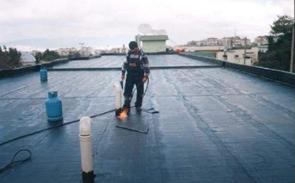
Solutions for thermal and waterproofing on roofs should be compatible with each other. Thermal insulation applications on roofs not only save energy but also prevent condensation (sweating), while waterproofing applications prevent rainwater from damaging the structure, forming a whole. In sloped roofs, waterproofing is done by laying waterproofing membranes under the roof covering or using waterproofing materials resistant to ultraviolet rays as the roof covering. Water that cannot penetrate the insulation is removed from the structure via valley and rainwater drainage pipes, completing the application. On terrace roofs, a slope concrete is first poured to direct the water. Waterproofing and thermal insulation applications are carried out based on expert assessments. Water is removed from the structure via drains and rainwater drainage pipes (Image 4).
3-Waterproofing Materials
Materials that provide water impermeability are called waterproofing materials. The materials used in waterproofing are categorized under three main headings according to their usage areas and properties.
I. Waterproofing Membranes
• Bituminous membranes: Oxidized Bituminous Membranes, Polymer Bituminous Membranes (APP/SBS modified)
• Synthetic membranes: PVC, EPDM, TPO, ECB/ECO, etc.
II. Coating-Based Materials
• Cement-based materials
• Acrylic-based materials
• Bitumen-based materials
• Polyurethane-based materials
III. Structural Waterproofing Materials
• Construction chemicals
• Joint materials
Waterproofing materials should be selected based on the intended use and the area of application; considering the water pressure in the environment, the structure of the ground, the expected movements of the structure, the potential loads on the product, climatic conditions, and the details in the structure.